
Odds and the bookmaker margin
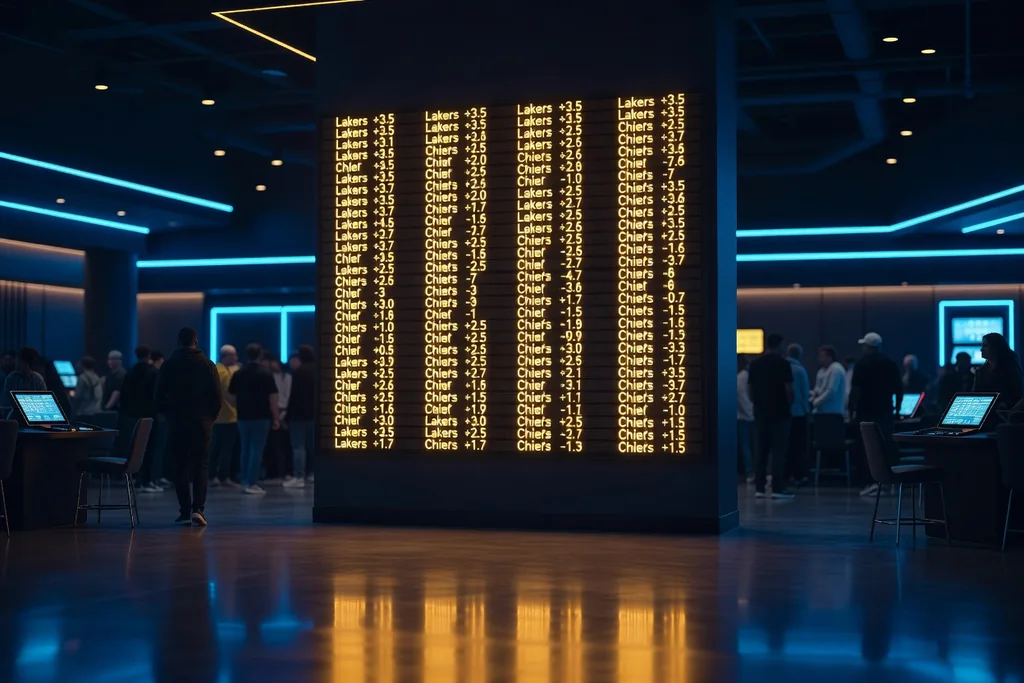
Odds are the most visible numbers on any betting page and the least understood. They look like predictions, they are read like probabilities, and they function as prices. Separating those three roles is the quickest way to think clearly about betting.
Once odds are understood as prices, several everyday intuitions turn out to be wrong, including the idea that a low odd on a strong team is a reliable signal.
How an odd is built
The platform estimates how likely each outcome is and converts that estimate into a price. It then adjusts the price so that the total implied by all outcomes exceeds certainty, and the difference is retained as revenue. That difference is the margin, sometimes called the overround.
The margin is why you cannot simply bet every outcome and break even. It exists on every market, though its size varies between markets, sports and providers.
Implied probability, in plain terms
Any odd implies a probability: the higher the odd, the lower the implied chance. Adding the implied probabilities of all outcomes in a market gives a figure above one hundred percent, and the excess is the margin made explicit.
This is a useful mental habit. When you look at a market, you are looking at a set of prices that already includes the operator's fee, not at a neutral estimate of what will happen.
Why odds move
Odds change as new information arrives: a team selection, an injury, weather, public money on one side. The platform adjusts to keep its position balanced, not only to reflect news. A drifting odd can therefore mean the operator's exposure changed rather than that the outcome became less likely.
Following price movement can be informative, but it is a record of money and information flow, not an oracle. Late money is sometimes knowledgeable and sometimes merely emotional.
What the numbers contain
| Component | What it reflects | What it does not tell you |
|---|---|---|
| Estimated probability | The platform's assessment | Whether that assessment is right |
| The margin | Operator revenue | How favourable the market is to you |
| Price movement | Money and information flow | What the result will be |
| Odds comparison | Differences between providers | Which selection will win |
| Long odds | A low implied chance | A good value bet |
Each row is a reminder that the price describes the market's state rather than the future. The last row is where hopeful reading usually happens.
The margin's practical effect
Because the margin is present on every bet, a player who stakes frequently pays it frequently. The effect is gradual and easy to miss across a single evening, and substantial across a season. It is the structural reason why long-term betting is an expense, not an income.
Anyone who claims to beat the margin consistently should be treated as selling something. Occasional winning runs happen to everyone; a permanent edge against a priced market is rare enough that public claims of it should be discounted entirely.
Reading odds better
- Convert the odd into an implied probability before deciding.
- Compare the same market across providers to see the spread.
- Remember that a short price is not a safe bet.
- Treat dramatic price movement as information, not instruction.
- Ignore any system advertised as beating the margin.
Recording bets to see the margin work
A simple log of bets, stakes and results makes the effect of the margin visible over time. Individually, each bet looks like a decision about a match; in aggregate, the record shows a steady cost alongside the genuine variance.
The log also corrects memory. Winning bets are recalled more vividly than losing ones, so an unaided impression of performance is systematically optimistic. Written records are indifferent to how a bet felt.
Reviewing the log monthly, calmly and away from the odds screen, is the most useful habit available to someone who bets regularly. It converts an experience into a picture.
In short
An odd is a price with a probability inside it and a margin on top. It tells you what a win pays, not what will happen, and the margin ensures that frequent staking has a cost before any result is known. Reading odds correctly makes betting less exciting and considerably more honest.
Read next
How sports betting works
From picking an event to settling a bet: what the odd represents and who decides the result.
Singles, expresses and systems
How the three core bet types differ in risk, and why combining selections changes the maths.
Live betting and cash-out
Why odds move during a match, what cash-out really does, and the traps of deciding in a hurry.